





























Mahjong tiles carry meaning from the objects they depict: coins, strung cash, bamboo, and written characters. A set holds three numbered suits, the honor tiles of dragons and winds, and the bonus flower and season tiles, each read as a small emblem of fortune.

The origin of Mahjong
Mahjong was born in China in the 19th century, most often traced to the coastal cities of the east, near Ningbo and Shanghai. It grew from older Chinese card games and kept their language. The circles began as coins. The bamboo stalks began as strings of coins, bundled together. The character suit counts in units of ten thousand. Each hand, in its way, is a small study of fortune.
Early sets were carved by hand from bone and bamboo, and the game was played wherever people gathered: in teahouses, in courtyards, around family tables at the New Year. Some say its name is linked to the sparrow, and to the sound of tiles shuffling across the table like birds gathering.
From China, mahjong traveled across Asia, to Hong Kong, Taiwan, Japan, and Southeast Asia, with each place shaping its own style of play. That is why a tile's meaning can shift from one table to the next. What has held steady is the heart of the game: patience, a feel for luck, and the company of the people around you.
In the 1920s, mahjong reached America, where it took on a style of its own and a devoted following, particularly in Jewish American communities. Today a new generation is discovering it around the world, and every one of them is sitting down to a game that began in China.
What Mahjong tiles mean
A mahjong set is made of three kinds of tile, and the meanings people wear come from what those tiles picture rather than from how the game is scored.
The three suits carry the numbers one through nine, four copies of each. Circles began as coins, the round pieces with square centers. Bamboo began as strings of those coins bundled together. Characters count in units of ten thousand. All three are money in different arrangements, which is why a hand of mahjong reads as a study of fortune before it reads as anything else.
The honor tiles sit outside the numbers. Three of them are known in English as dragons: red, green and white. Four more are the winds, east, south, west and north, which order the seating and the turn of play. Honor tiles cannot be built into runs, only into sets of their own, which is part of why they are held to be worth more.
The bonus tiles are the flowers and the seasons, four of each. They are not played into a hand at all. When drawn they are set aside, replaced with another tile, and counted at the end, which makes them the closest thing the game has to unearned luck.

Meaning behind each tile
The tiles carry a long history, and their meanings vary by region and tradition. What follows reflects their most widely shared associations, along with the intention chosen for each piece.
The Dragons
The three dragon tiles stand apart from the numbered suits. Known as honor tiles, they hold a special place in the game.
The Red Dragon
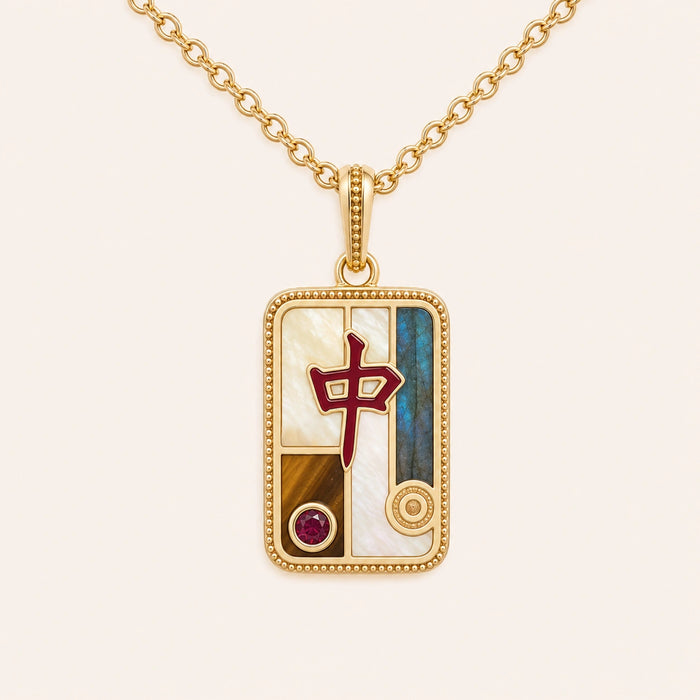
The Red Dragon bears the character 中 (zhōng), meaning center. It is often linked to archery and the arrow that finds the middle of its target. Here, it becomes a tile of inner strength: holding your ground while everything around you moves. The Empowered Spirit Red Dragon Necklace keeps that reminder close.
The Green Dragon
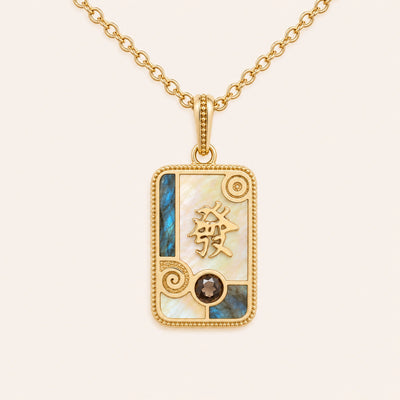
The Green Dragon carries 發 (fā), meaning to flourish. The same character appears in gong xi fa cai, the Lunar New Year greeting that wishes prosperity. It is the collection's tile of abundance, offered in two designs: the Prosperity Green Dragon Necklace and the Fortune Flow Green Dragon Necklace.
The White Dragon
In many sets, the White Dragon is left blank or marked with a simple frame. Its emptiness is its meaning: a clear mind, a clean slate, and space for what comes next. The Clarity White Dragon Necklace brings that stillness into everyday wear.
The Bamboo Suit
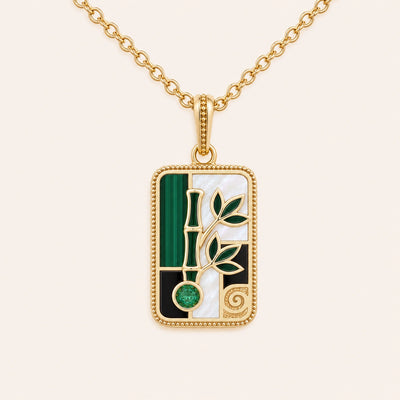
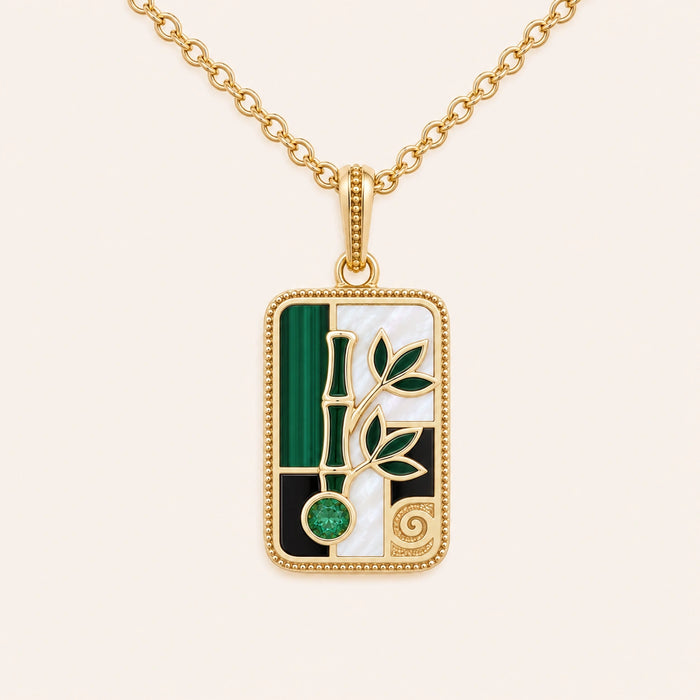
Bamboo grows quickly and bends in the wind without breaking. The bamboo suit, known to players as bams, carries that same spirit of steady growth and resilience.
The Peacock
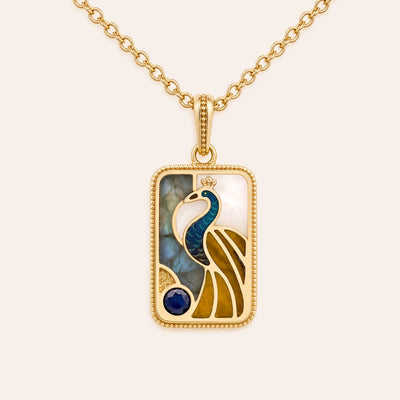
The first tile of the bamboo suit traditionally shows a bird rather than a stalk. In many sets, it is a peacock with its feathers fully open. Other sets feature a sparrow, a bird often connected to the name of the game itself.
The peacock is a symbol of beauty and self-possession, of stepping fully into your own light. It appears in the Regal Spirit One Bam Necklace.
Two Bam and the Bamboo Tiles
Two Bam shows a pair of stalks rising side by side, an image of shared progress that builds season by season. The bamboo tiles appear across three designs: the Flourishing Spirit Two Bam Necklace, the Bamboo Fortune Necklace, and the Guided Growth Bam Suit Necklace.
Myths and misconceptions about Mahjong
Mahjong solitaire is not mahjong. The tile-matching game that came bundled with desktop computers uses mahjong tiles and nothing else from the game. Mahjong is played by four people, with turns, discards and calls, and the tiles mean what they mean because of how they move between those four hands.
Tile meanings are not fixed. Hong Kong, Taiwanese, Japanese riichi and American mahjong each developed their own rules, their own scoring and their own emphasis. A tile that is central in one style barely matters in another. The associations here are the widely shared ones, not a single official reading.
The dragons are not dragons. The English name arrived with Western sets in the 1920s. In Chinese the three tiles are 中 (center), 發 (flourish) and the blank, sometimes called 白板, the white board. Knowing that changes how they read: not three beasts, but three states, holding your ground, growing, and starting clear.
Flowers and seasons are two different sets. A standard set carries four flowers and four seasons, eight bonus tiles in total. They are often grouped together because they work the same way in play, but they are not the same tiles.

Is it okay to wear Mahjong jewelry?
Yes. Mahjong is a game, not a religious object, and it has been shared freely wherever it has traveled for more than a century. It is Chinese in origin, and worth naming as Chinese rather than describing as generally Asian or vaguely ancient. From there it spread across Hong Kong, Taiwan, Japan and Southeast Asia, and reached the United States in the 1920s, where it found a lasting home in Jewish American communities. Few games have been adopted by so many people so quickly.
What matters is wearing the tile with its meaning intact. The characters on the dragons are read every day by millions of people. A tile worn as a pure graphic, with no idea what 發 says, is the version that sits badly, and the fix costs nothing: know what your tile means before you wear it.
The same care applies to how a piece is made. Every pendant in the Mahjong Collection is handcrafted by artisans in Thailand, cut to the proportions of a real tile and set by hand with natural stone, so no two pieces come out quite alike. The form is followed rather than borrowed, which is the part we can speak for.
How to wear Mahjong jewelry
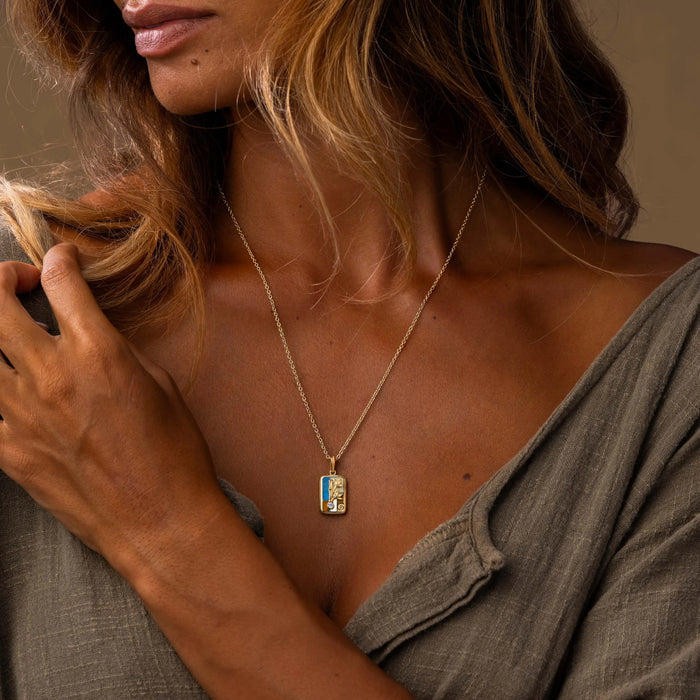
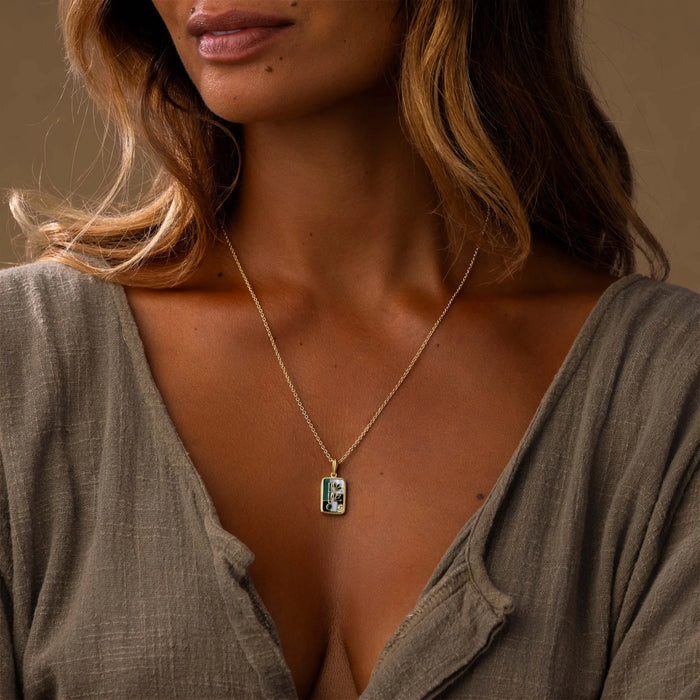
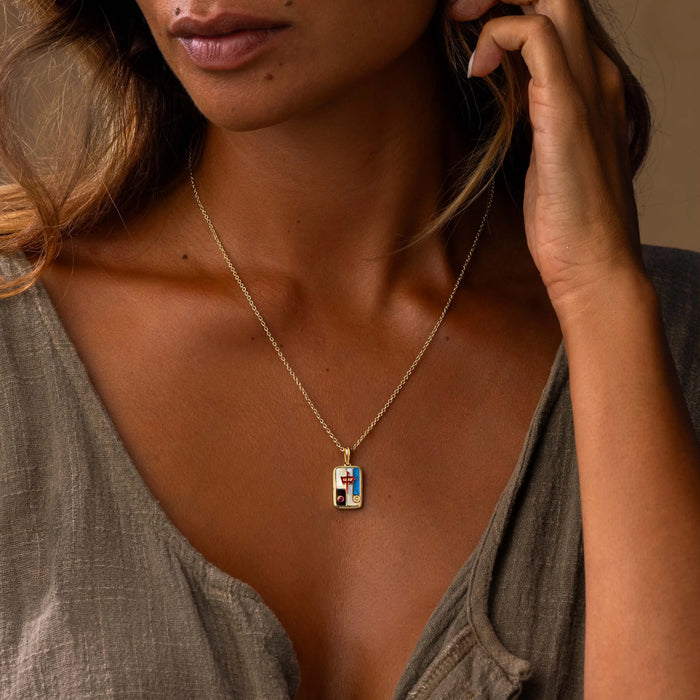
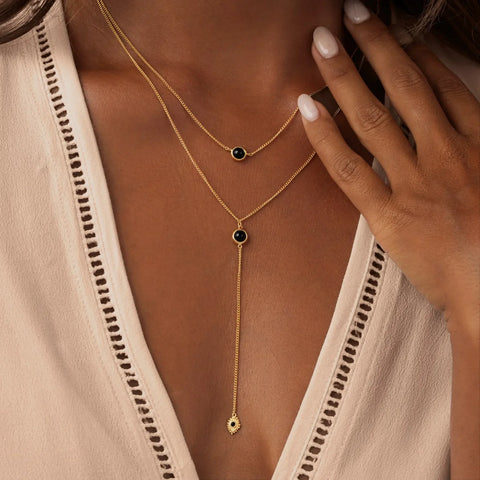
A tile pendant is longer than it is wide, so chain length decides how it reads. Around 16 to 18 inches sits the tile at the collarbone, where the carved face stays visible above a neckline. Longer, at 20 to 24 inches, drops it to the sternum, which suits the larger Classic Tiles and layers cleanly under an open collar.
Two tiles worn together is the natural way to wear this collection, since a mahjong hand is built from more than one tile. The pairings that work are the ones that say two different things: Red Dragon with Green Dragon for steadiness alongside growth, White Dragon with the Flower tile for a clean start and the luck that follows it, Two Dot with One Bam for partnership beside self-possession.
Give the two chains a few inches of difference in length so the tiles sit apart rather than knocking together.
How to choose your tile
In mahjong, every turn begins with a draw. You pull a tile from the wall, weigh it against your hand, and decide whether it belongs. When another player discards the tile you have been waiting for, you call for it and claim it as your own.
Choosing your pendant works the same way. Each tile holds a distinct energy, and the one you reach for is the one you are calling into your life. Begin with what you need most right now, or the season you are stepping into, and draw the tile that answers it.
-
Strength and steadiness: the Red Dragon
-
Prosperity and growth: the Green Dragon
-
Clarity and a fresh start: the White Dragon
-
Confidence and self-expression: the Peacock
-
Patience and resilience: the Bamboo tiles
-
Balance and partnership: the Two Dot
-
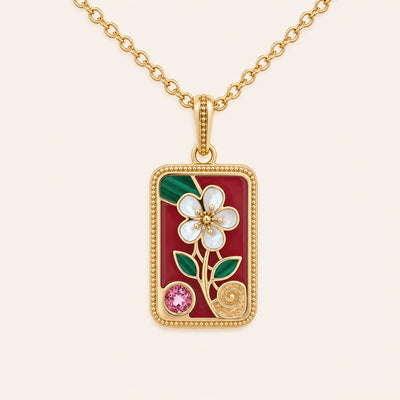
Grace and unexpected blessings: the Flower tile
Two tiles can also be worn together, the way a hand is built from many.

The Mahjong Jewelry Collection
Every piece in the Mahjong Collection begins with the tile itself, its shape, its symbol, and the meaning it has carried to the table for generations. The collection comes in two expressions: Classic Tiles, which stay true to the familiar form and carved symbols of a traditional tile, and Modern Take, which reimagines each tile with an artist's eye while keeping its meaning at the center.
Each pendant is set with natural stones chosen to deepen its intention, from mother of pearl, malachite, and labradorite to tiger's eye, onyx, emerald, ruby, sapphire, and citrine, all finished in gold. The collection is handcrafted by artisans, and because no two stones are ever quite alike, each pendant is entirely its own, much like the hand you are dealt.


